

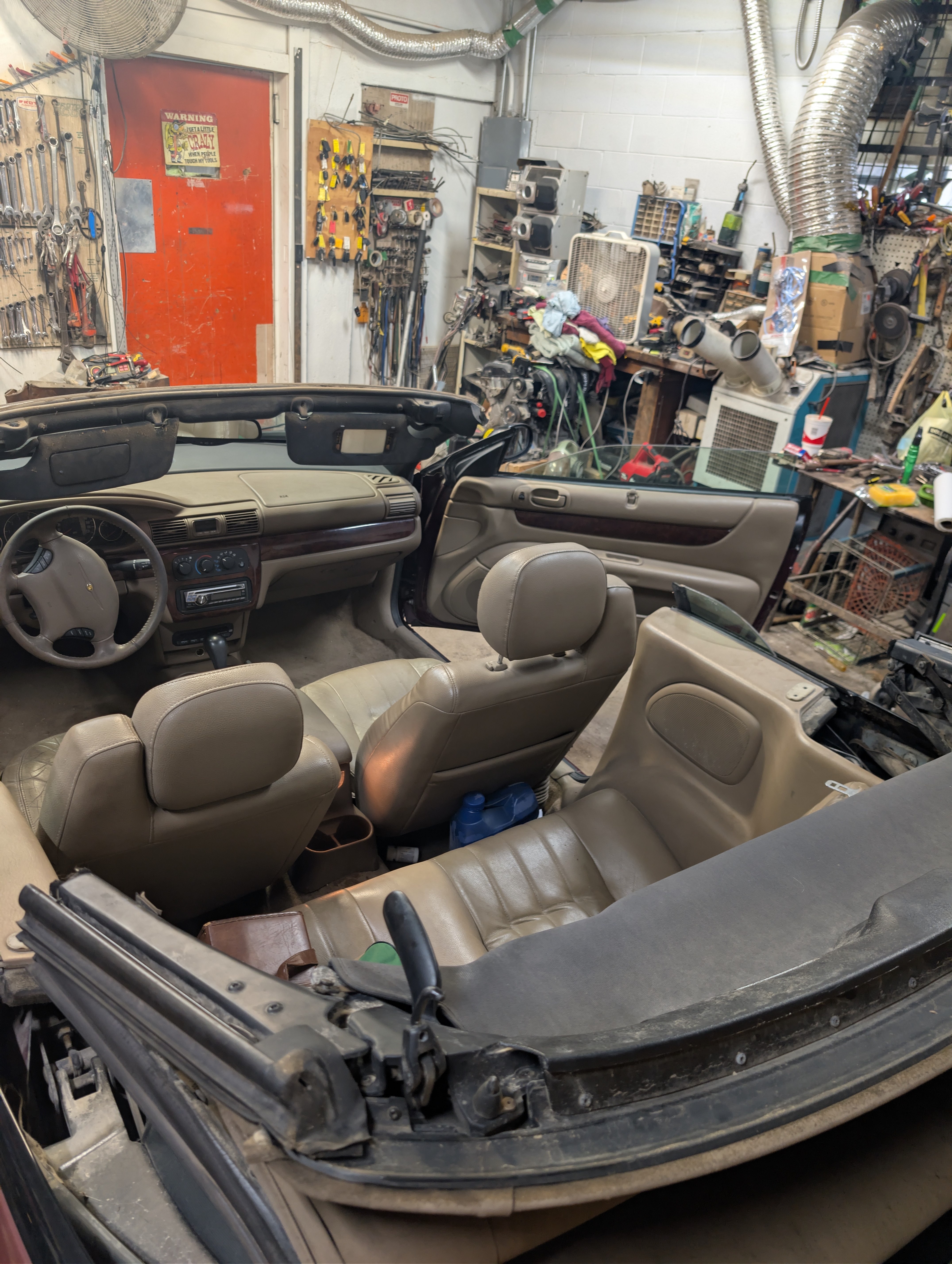
2001 Chrysler Sebring LXi, 2.7 V6
This thing was sitting out for 3 years under a tree, it’s gotten the full cleaning treatment, some engine work, and an hour drive to get a sensor for the transmission (thank god it worked).
Luckily when I was ready to leave all the windows got stuck down and I had to spend 8 hours rebuilding every single regulator and nightmare steel wire hell wheel so I wouldn’t get rained on. I curse whoever decided unflexible untreated steel wire was great for moving windows up and down.
At least it drove me home today
Chrysler, fucking Chrysler, that’s who. And this is the kind of difference you see between companies like Chrysler (in my opinion the worst) and companies like Toyota and Honda, who would use completely sheathed cable, and then a plastic chain for the exposed part (I’ve worked on both and seen this first hand, so I know exactly what you’re dealing with).
Well done! I assumed you lubed the daylights out of the steel with something that will stick around, like lithium or even never seize (which usually has graphite in it, which doesn’t easily wash off).
The shitty engineering competition is fierce among American automakers.
Couple of runner up ideas that I’ve personally encountered:
Connect every climate control damper to the modulator with a thin piece of brittle plastic that will break after 10 years, requiring removal of the entire dashboard to repair. – Ford, 3rd Gen Explorers and Lincoln Aviators (2002-2005)
Place the distributor – which happens to be very sensitive to fluids – immediately under the water pump so when the water pump bearings inevitably fail, the distributor gets wet and is destroyed. – GM LT1 Engine (1992 - 1997)
I remember working on the first Toyota I owned and thinking, “Wow! These people really put a ton of thought into where everything is located. This is nice.” We’ve had a Toyota as the primary family vehicle since.
Currently used some marine grease cause we have to replace the regulators anyways due to the plastic housing being completely shredded.